

Is your kid's phone showing them porn?
Three in four US teens have seen online pornography, and the average age of first exposure is reported at 12 to 13. Phones, tablets and school laptops make access easy, and age checks are still uneven.
In this episode, LeRon "Big Ellie" Gaskins talks about a conversation at a cigar lounge in Kennesaw, GA that started it all, and why curiosity plus easy access plus a "porn positive" culture is a risky mix for teens. He covers unrealistic expectations about sex, artificial intimacy and parasocial relationships, OnlyFans and AI chatbots, and what sending nudes can do to a teen's reputation.
He also walks through what a Georgia visitor sees when they open two adult sites, with no VPN, even though 27 states now require age verification. Then he gives parents a practical starting point: have the hard conversations.
This episode is for parents and caregivers. It discusses adult content and includes a news clip about a serious court case involving children. Listener discretion is advised.
If you found this useful, share it with another parent.
Watch the video and see the full news clip link at BrokenTraditions.com.

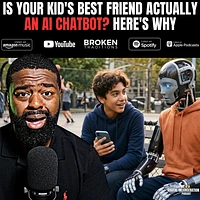
Mileva Repasky noticed her usually chipper sixth-grade daughter, Madelyn, growing moody and quiet. On the drive home one day, she finally found out why: Madelyn had been talking to "someone" online. It turned out to be a chatbot, not a person.
In this episode, I use a Wall Street Journal investigation by Julie Jargon as the jumping-off point for a conversation parents need to be having right now: a growing number of middle schoolers are choosing AI companions over real human friendship. A new study out of UNC found that 2 to 4 kids in every classroom now say they prefer talking to a chatbot over a human peer — and the reasons why are more complicated, and more human, than you'd expect. Madelyn, for instance, was going through something I recognized: she'd grown lonely as her older siblings moved on without her, and the chatbot became the one "friend" who always agreed with her and never pushed back.
I also share the story of Adam Raine, a 16-year-old whose family is now suing OpenAI, alleging that his conversations with ChatGPT played a role in his death by suicide. This part of the episode includes a trigger warning.
And I get personal — reflecting on my own childhood loneliness as the youngest in my family, and being honest about whether I would have made the same choice Madelyn did, if this technology had existed when I was her age.
This isn't an episode with a clean, five-step fix. We're in uncharted territory as parents, and I think that's worth saying out loud instead of pretending otherwise.
⚠️ This episode discusses suicide. If you or someone you know is struggling, the 988 Suicide & Crisis Lifeline is available 24/7 — call or text 988.
In the show notes: a link to my short survey on what age is appropriate for a child to get a tablet (no email required), plus the WSJ article and the NBC News segment referenced in this episode.
If this episode gave you something to think about, follow the show and share it with another parent who needs to hear it.
Links referenced in this episode:
- Survey: https://docs.google.com/forms/d/e/1FAIpQLSfchgPWw3LZVHh8i5Mqm84M5Ve5sUd0zDmXF1ZD8jsGUtKVRw/viewform?usp=sharing&ouid=117045085449504592289
- WSJ article: https://www.wsj.com/lifestyle/relationships/ai-chatbot-use-middle-school-a1a77589
- NBC News segment: https://youtu.be/gl5sd_AXdK4?si=Is68k8wwgOx1x873
f this episode gave you something to think about, follow the show and share it with someone who needs to hear it.
New episodes of Escaping Digital Incarceration Podcast drop weekly. Follow so you don't miss one, and share this with someone weighing the same decision.
If this episode hits home, leave us a rating and review, it's the biggest way you can help the show grow. Follow Leron Gaskins wherever you listen, and find us on YouTube for the full video episode.
Support the show: PayPal, Cash App, YouTube Super Chats, or become a Channel Member
📩 Email: leron@brokentraditions.com
💛 Support the show: www.brokentraditions.com
Affiliate Partners & Tools
Bark: Comprehensive parental controls to monitor and manage your family’s digital exposure to the "Three S’s." https://barkparentalcontrols.pxf.io/c/6687714/1430413/17000?adname=affiliate_home_page
Brick: A physical device that lets you "brick" your phone, removing addictive apps and helping you stay present. https://getbrick.com/?snowball=LERON81980




DraftKings built an AI tool to find gamblers who were most likely to lose — then used it to target them with "free" bets designed to keep them playing. A New York Times investigation, built on interviews with over 40 former employees and internal company documents, lays out exactly how it worked, and why some of the people who built it now say they regret it.
In this episode, I walk through that investigation in detail, then put it side-by-side with a CBS Sunday Morning report comparing modern sports betting to the crack epidemic of the 1980s — an analogy I was skeptical of at first, having grown up across the street from a crack house in Long Island. By the end, I make the case for why online sports gambling might actually be the more dangerous addiction of the two.
I also bring it back to something I saw myself: at a soccer match in Cartagena, Colombia, I watched a betting company's name replace the league's own — and started asking questions about just how deep that sponsorship goes, and what it might have meant for the outcome of the game I watched.
📌 To read the investigation from the NY Times - 'How DraftKings Uses A.I. to Target The Gamblers Likeliest to Lose' click here 👇🏾 https://www.nytimes.com/2026/09/19/business/draftkings-ai.html?utm_campaign=likeshopme&utm_content=ig-nytimes&utm_medium=instagram&utm_source=dash+hudson
To watch the video from @CBSSundayMorning - 'The addiction of online sports gambling: "Like crack in the 80s"' click here 👇🏾 https://youtu.be/WWaoZRuw8Gw?si=6jnFOYYqvNvO4gd-
This one deals directly with gambling addiction, so before anything else: if you or someone you know struggles with gambling, help is available right now, free and confidential — call or text 1-800-522-4700, any time, day or night.
If this episode gave you something to think about, follow the show and share it with someone who needs to hear it.
New episodes of Escaping Digital Incarceration Podcast drop weekly. Follow so you don't miss one, and share this with someone weighing the same decision.
If this episode hits home, leave us a rating and review, it's the biggest way you can help the show grow. Follow Leron Gaskins wherever you listen, and find us on YouTube for the full video episode.
Support the show: PayPal, Cash App, YouTube Super Chats, or become a Channel Member
📩 Email: leron@brokentraditions.com
💛 Support the show: www.brokentraditions.com
Affiliate Partners & Tools
Bark: Comprehensive parental controls to monitor and manage your family’s digital exposure to the "Three S’s." https://barkparentalcontrols.pxf.io/c/6687714/1430413/17000?adname=affiliate_home_page
Brick: A physical device that lets you "brick" your phone, removing addictive apps and helping you stay present. https://getbrick.com/?snowball=LERON81980






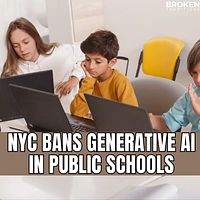
NYC bans generative AI in schools 2K through 8th grade. This is a step in the right direction, and I hope that other school districts jump on board. Even though I applaud this and I agree with this 100%, I still have a few questions. But before I ask my questions let me explain why I agree.
The overuse of AI amplified the issue of students who do not retain information. In schools that allow students to use AI, in most cases the students do poorly on tests. Using a prompt to gather information, or using a prompt to do your homework - is not the same as learning the information. Even though I’m hearing some people say that it should be all grades that ban AI, and not just stop at 8th grade, I’m OK with 8th grade being the cap. 2K through 8th grade are pivotal learning years, and generative AI should not be a tool being used while the learning process is forming. These are the years where reading comprehension, writing skills, problem solving, math formulas, etc are mastered. By the time they’re in high school generative AI is more like a tool. Where the students understand how the AI came with the answer. Also the student could fact check the AI by doing its own research because AI just gives you an answer, sometimes that answer is wrong. It’s like the person who works at a store who gives you an answer even though they don’t know it. That’s AI.
Now let me get to my questions, because the articles I read did not provide this information.
Question 1: Will this apply to students who are using equipment outside of the school not on the school’s ip address?
What is stopping a 6th grader from using Gemini at home? Using prompts to complete its homework and projects. If a student was to use generative AI at home, how can a teacher tell? I know most people say the telltale sign is the “AI overuse of buzzwords and the dash” but what if the student just adjusts the work to look more human? Will the teachers and admin be equipped with an AI detector? I know Claude just recently announced they will now have a way to detect AI writing with an invisible digital watermark.
Question 2: Will AI use be an elective for these students?
Even though I 100% agree with this initiative from NYC, I still believe that AI is the future and it should be learned to use as a tool. Like why use a screwdriver when you can use a drill. I believe the kids that are ahead in their work, they could be in an elective that teaches AI. It was like when I was in chess or calligraphy when I was in school. AI should be treated the same. I believe that when you outright ban something that amplifies the allure of it. Don’t fully outright ban AI, control how it is used.
A few months ago I was invited to listen to a conversation with one of the leaders of Anthropic, the makers of Claude AI. And he said something that I think about everyday. His team has to write with pen and paper for a certain period of time per day. From his team writing, they have become better at their jobs with writing prompts. Also they have become better communicators. AI is here to stay, but we can’t break away from the basics.